

Walking Away - Literally
Sleepy Saturday: Digital Sabbatarianism™ - issue #5 | Saturday, March 7, 2026

Where screens stop, and souls start.
Here’s a strange discovery from my Digital Sabbath practice: when I don’t touch keyboards or look at screens in the morning, I’m far more likely to get outside.
Not because I’m forcing myself. Because there’s nothing pulling me back in.
No email to check “one more time.” No news cycle demanding I stay informed about the latest catastrophe. No notification badge glowing red, whispering that something—anything—requires my immediate attention.
Without the pull, leaving becomes easy. The door is right there. And suddenly, so is the sun.
Our Bodies Are Designed to Move. Our Phone Is Designed to Stop Us.
This isn’t hyperbole. The attention economy runs on one metric: time on device. Every second you spend walking outside is a second you’re not generating data, not viewing ads, not engaging with content.
The apps on your phone have been engineered—deliberately, expensively—to keep you stationary and staring. Game designers call the micro-feedback that makes actions addictive “game juice.” The whoosh when you send an email. The heart animation when someone likes your post. The red badge that says “unfinished business” until you clear it.
Every app on your phone has been juiced. (See our Research Rebellion Tuesday deep dive on how the entire digital ecosystem uses gaming addiction, mechanics.)
Walking is the opposite of game juice. It’s slow. The feedback is delayed. The “reward” is just... feeling better. Which apparently isn’t enough to compete with a notification badge.
Gateway Behavior
Researchers who study habit formation have identified “gateway behaviors”—small actions that cascade into larger lifestyle changes. Exercise is the classic example. People who start walking regularly tend to eat better, sleep better, and drink less—even when those weren’t their goals.
But there’s a gateway before the gateway: putting down the phone.
I’ve noticed this in my own practice. Digital Sabbath mornings start without the phone. Without the phone, there’s no scroll. Without the scroll, there’s no pull to stay inside. Without the pull, the walk happens almost automatically, at least until we adopt another dog.
The phone isn’t just a distraction from walking. It’s what makes walking feel unnecessary. Why go outside when the entire world is already in your hand?
Walking Without the Tracker
Here’s a heresy: try walking without tracking it.
No step counter. No fitness app. No route map to share on social media. Just walking—the way humans did it for 200,000 years before anyone thought to gamify it.
The fitness tracker is a fascinating case of game juice infiltrating something inherently healthy. Walking is good for you. But the step count—the streak, the badge, the progress bar—turns walking into another game. Another score to optimize. Another achievement to unlock.
I’m not saying trackers are evil. But notice what happens when the tracker dies mid-walk. Do you feel like the walk “counted”? Or does part of you feel like you wasted the effort?
If a tree falls in the forest and your Apple Watch doesn’t record it, did you really burn any calories?
🔬 Quick Science
Psychiatrist Alok Kanojia, who treats gaming and internet addiction, notes that dopamine—the brain’s reward chemical—depletes when overstimulated. “The earlier you spike your dopamine, the more depleted you are when you actually need to get stuff done. If you game first thing in the morning, your brain’s like, ‘Cool, that was the highlight of the day,’ and now everything else feels like a slog.”
Replace “game” with “scroll,” “check email,” or “watch the news,” and the principle holds. Morning screen time doesn’t just steal morning time—it steals motivation for everything that comes after.
Walking first, before screens, reverses the equation. The slow serotonin of movement primes the brain for engagement rather than depletion.
💬 From the Research
“Serotonin and true happiness do come from effort. And the irony is, the more you chase an easy life, the harder your life becomes. But the more you’re willing to do hard things today, the easier your life becomes tomorrow.” — Dr. Alok Kanojia
📱 This Week’s Practice
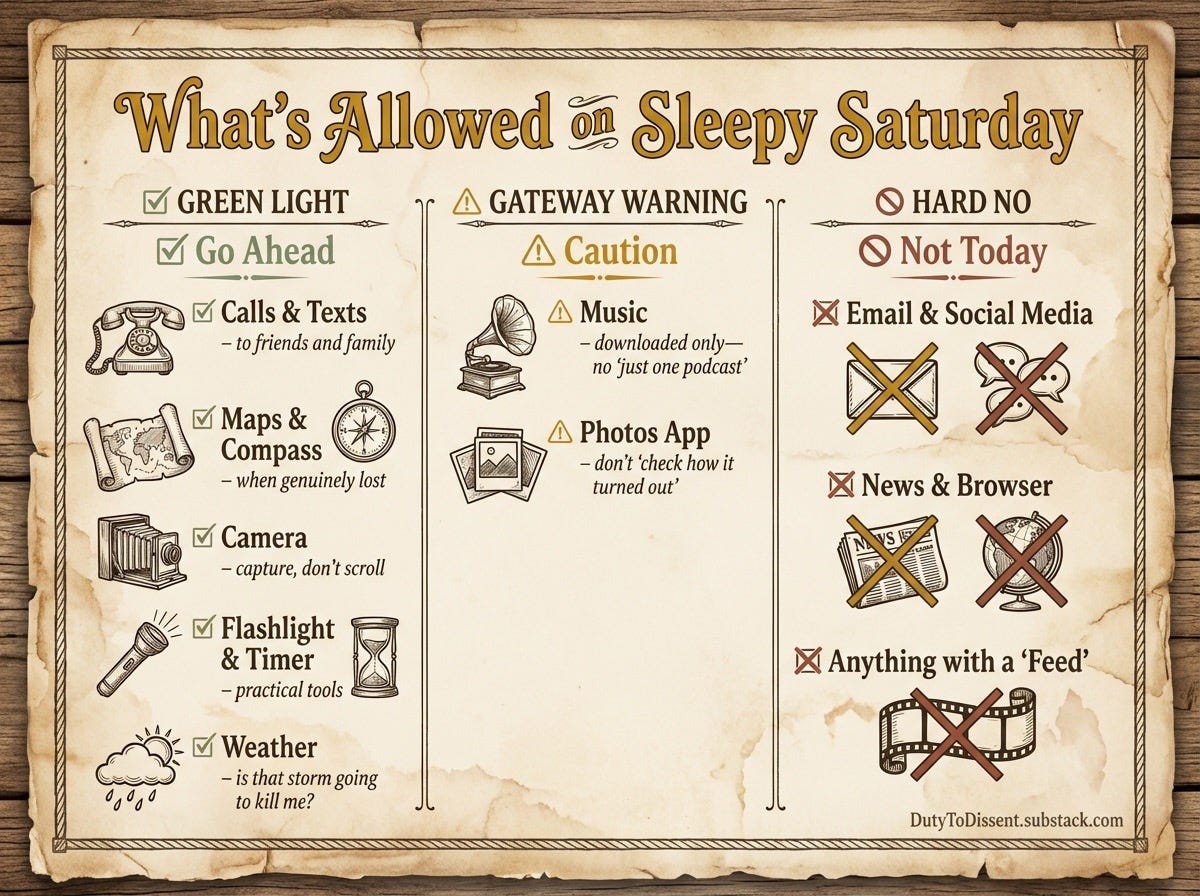
The Challenge: One walk on Saturday without a phone. Leave it at home. Or if that terrifies you, leave it in the car. Or use it strictly for texting or calling friends or family.
📓 Analog Hours
What actually happened when the phone stayed home:
• Morning without screens → door opens easier
• Found a park I’d never visited despite living nearby for years
• Walked without tracking—still counted, despite what my brain tried to tell me
• Learned that silence has its own soundtrack
📅 Next Week on Sleepy Saturday
Week 6: “When the Buzzing Stops”
What happens in your mind when the notifications finally stop? Next Saturday, we explore the silence—and what it reveals.
Sunset this Friday in your area: timeanddate.com/sun
Now close this screen. Your Digital, Sleepy Sabbath awaits.
DutyToDissent.substack.com
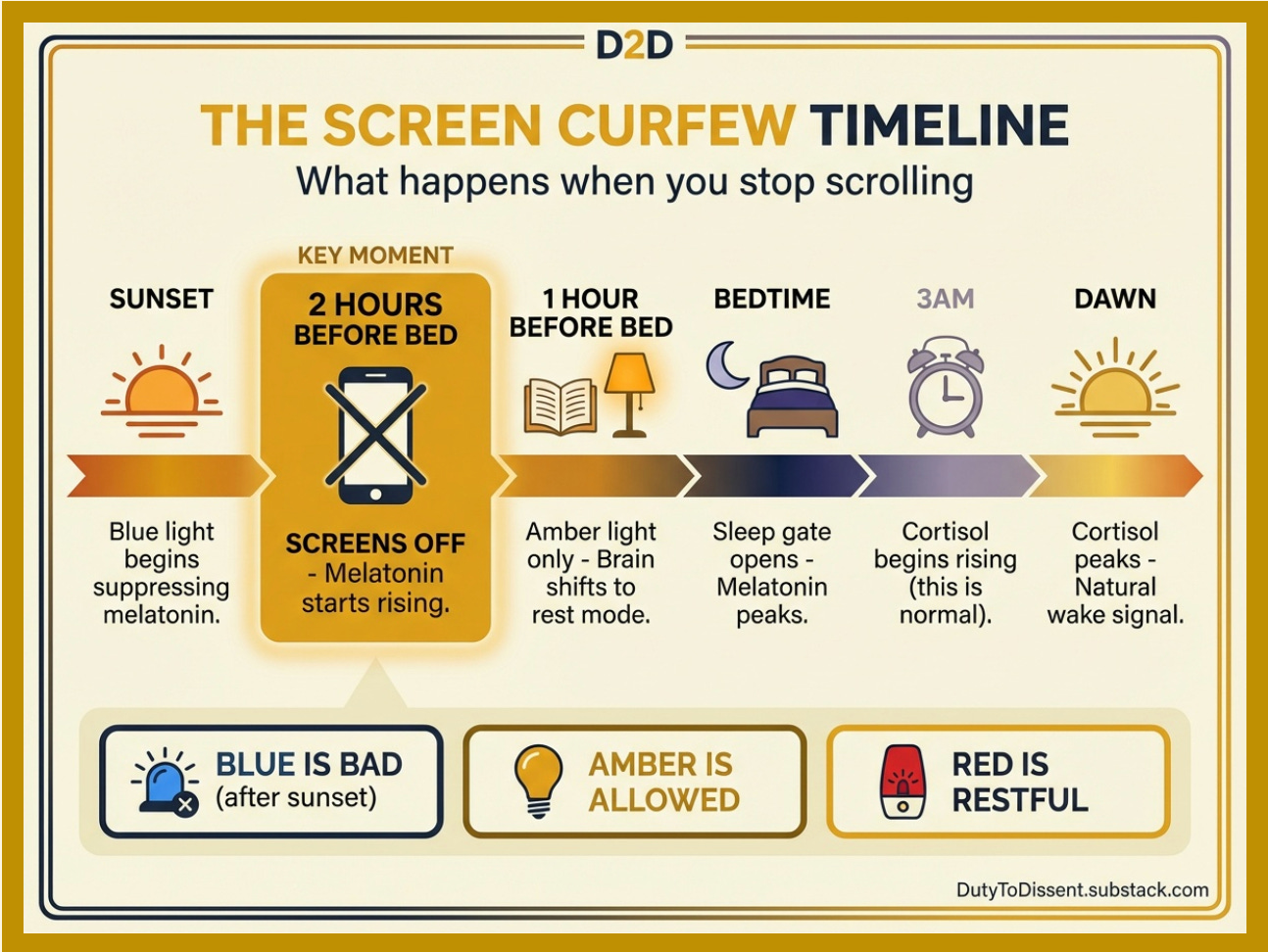
I have been fatigued lately. I just started following what I saw about two of the causes of fatigue and what to do about them. One has to do with the amount of water I drink which is not enough. The other, however, is right on target with this post, turning off the phone at least an hour before bed.
Whether the 7.5 hours of sleep, including an amazing 2.3 hours of REM sleep was due to either of those changes, I don’t know but I’m going to continue and see what happens.
PS. I have never gotten more than a little over an hour of REM sleep since I started tracking it a couple of years ago!